Why Socks Are the Detail That Dates a Tenniscore Outfit
Quick Answer: Sock height sets the visual break on the leg, and where that break lands decides whether an outfit reads current, dated, or costume. Crew socks — hitting just above the ankle bone — are the contemporary default and the most flattering for most people. No-shows read as athletic-functional, quarter socks read as 2010s, and knee-highs read as either deliberately retro or fancy dress depending entirely on the rest of the outfit.
You have the skirt, the polo, the sneakers. Something reads slightly off and it is four inches of cotton.
Why does sock height matter so much?
Because it creates a horizontal line on the leg, and horizontal lines are the most visible thing in an outfit.
The eye reads horizontal breaks as division points. A sock’s top edge is a hard, high-contrast horizontal line — usually white, against skin — and it sits in the most visually active part of a leg-baring outfit. Nothing else in a tenniscore look creates a line that sharp.
Where that line lands changes the proportion of the whole outfit. A break just above the ankle bone leaves the calf uninterrupted and the leg reads long. A break at mid-calf divides the calf at its widest point, which is the least flattering position available for most people. A break at the knee closes the leg off entirely and creates a completely different silhouette.
And height carries a period signal. Sock height is one of the fastest-moving markers in casual dressing — it dates a photograph almost as reliably as a phone shape. No-show socks read as mid-2010s athleisure. Quarter socks read as slightly later. Crew socks are the current default. Knee-highs are a deliberate reference rather than a neutral choice.
Which means the sock is not a minor accessory in this particular aesthetic. Tenniscore is built on a small vocabulary of white sneakers, a pleated skirt, and a knit or polo — there is very little going on, so every visible element carries proportionally more weight. In an outfit with three elements, the fourth is not a detail.
What does each height actually read as?
Five options, with what they signal and who they suit.
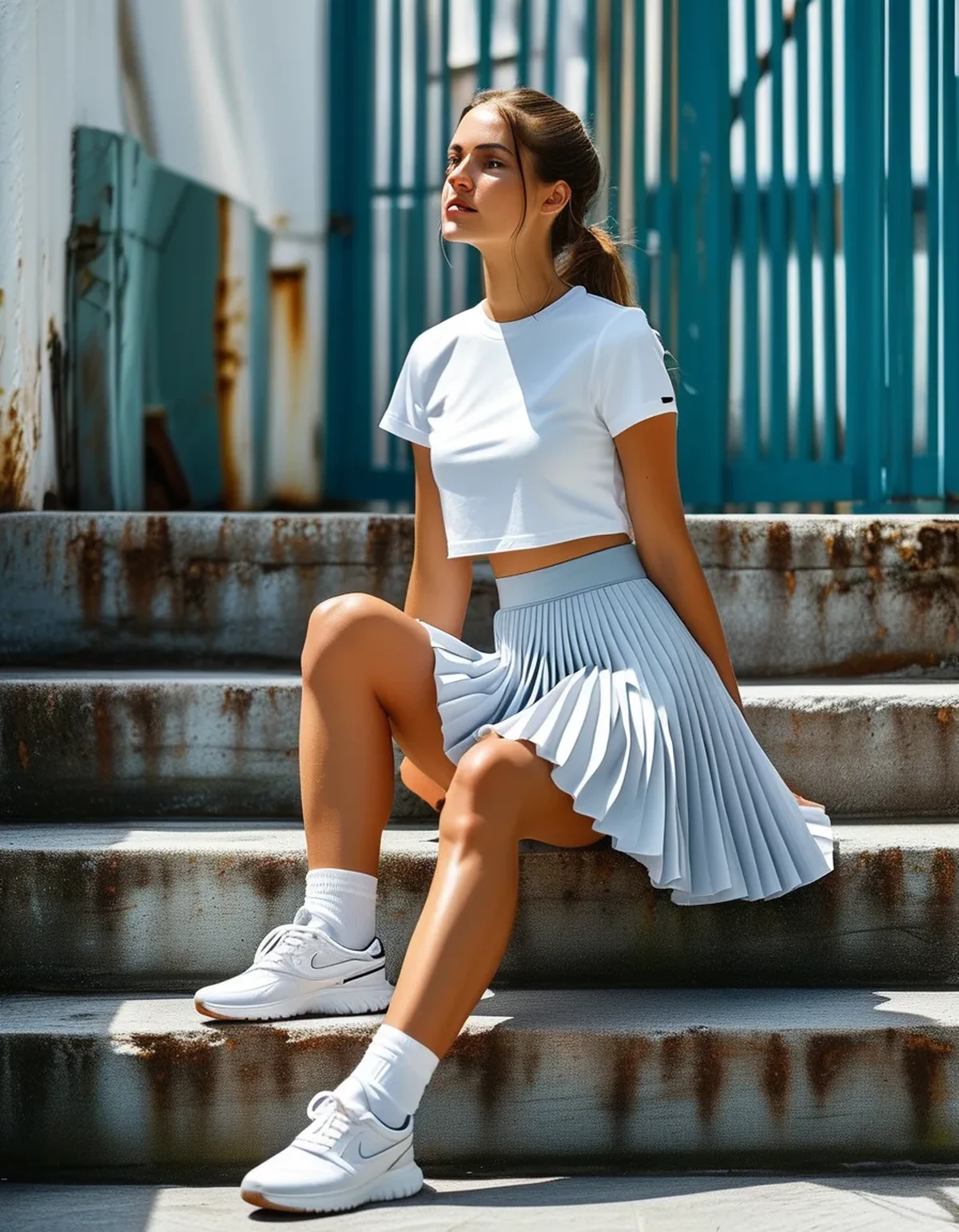
Crew — just above the ankle bone, roughly 3 to 5 inches of cuff. The current default and the most reliably flattering. It leaves the calf uninterrupted, reads contemporary, and works with both low and high sneakers. If you own one type, own this.
Quarter — just covering the ankle bone. Functional, and it reads as slightly dated in a styled outfit — it was the standard athletic sock height through the 2010s. Fine in a gym context, less so in a styled one.
No-show — invisible above the shoe. Reads as bare-legged, which is a genuine choice rather than a wrong one. It works well with low-profile sneakers and a very minimal look, and it removes the horizontal break entirely, which some people prefer. The catch is that it reads athletic-functional rather than styled, and it makes chunkier sneakers look disconnected from the leg.
Mid-calf — the top edge at the widest part of the calf. The least flattering position for most people and hard to make work. Where it does work is with a longer skirt or shorts that reduce the amount of visible leg, or as a deliberate sporty reference with a specific shoe.
Knee-high — over the knee or just under it. A strong deliberate statement. With a pleated skirt and a cardigan it reads as intentional retro or academia; with the wrong shoe it reads as a costume. The determining factors are shoe choice, whether the skirt length relates to the sock, and whether the rest of the outfit is committed to the same reference.
And a rule that holds across all five: the more visible leg there is between hem and sock, the more the sock height matters. With a short skirt, the sock is a major element. With a longer skirt or trousers, it is genuinely a detail.
How do the other pieces change the answer?
Sneaker profile and skirt length are the two variables that decide which sock works.
Sneaker profile first.
- Low, slim white sneakers — crew or no-show both work. Crew reads more styled, no-show more minimal.
- Chunky or platform sneakers — crew socks, essentially always. A chunky shoe with a no-show sock looks disconnected, because there is a visual gap between a heavy shoe and a bare ankle. The sock bridges it.
- High-top sneakers — crew socks that show above the collar, or the sock disappears entirely and reads as none.
- Loafers or flats with a tenniscore skirt — a short crew or a fine ribbed sock, and this is one place a no-show works well.
Then skirt length.
- Short pleated skirt, mid-thigh — maximum visible leg, so crew is the safest and most flattering.
- Mid-thigh to just above the knee — crew or knee-high both work, and knee-high becomes a genuine option because the gap is small enough to read as deliberate.
- Knee-length or longer — the sock matters much less, and mid-calf becomes wearable because there is less leg on show to divide.
And the texture question. A ribbed sock reads more considered than a flat one, and a cuff with a subtle stripe or logo band is the detail that makes an outfit look styled rather than assembled. Thin, sheer sports socks read as gym kit; a slightly substantial cotton rib reads as clothing.
Colour, briefly: white is the default and it is the strongest contrast, which is why it draws the eye. A sock matching your skin tone or the skirt reduces the break entirely and is the move if you want less attention on the leg division. Cream against bright white sneakers reads slightly off — match the white or go clearly different.

Myth vs Fact: Tenniscore Socks
Myth: Socks are too small a detail to change an outfit. Fact: In an aesthetic with three or four visible elements, the sock is one of them. It creates the highest-contrast horizontal line in the whole look, in the most visually active zone. Outfits that read almost-right very often have exactly this wrong.
Myth: No-show socks are always the safest choice. Fact: They are the safest choice with slim low sneakers and nothing else. With a chunky sneaker they create a visual disconnect, and they read as functional-athletic rather than styled. They are also the least forgiving option if your shoes cause any rubbing at the collar.
Myth: Knee-high socks are inherently costume. Fact: They are a strong reference that requires commitment from the rest of the outfit. With a pleated skirt, a fine knit, a loafer or a low sneaker, they read as considered. With a platform trainer and a graphic tee they read as fancy dress. The sock is not the problem; the mixed message is.
Myth: Sports socks and styled socks are the same thing. Fact: A thin, glossy performance sock with mesh panels reads unmistakably as gym equipment. A cotton rib with a defined cuff reads as clothing. They cost roughly the same and they are not interchangeable in a styled outfit.
Myth: Sock height does not date. Fact: It is one of the fastest-moving markers in casual dress, which is precisely why it is so effective at making an outfit read current or not. The specific heights in and out of favour shift every few years, and crew is the present default rather than a permanent answer.
What should you actually own?
Three or four pairs, chosen deliberately, and one autumn variation.
The core set:
- Three or four pairs of white cotton crew socks with a ribbed cuff. This is the workhorse and it covers the large majority of tenniscore outfits. Buy the same pair repeatedly rather than a mixed drawer — whites do not match across brands and a mismatched pair is visible.
- One pair of ribbed crew socks in cream or a soft neutral, for outfits where bright white would be too much contrast.
- A pair of no-shows for slim low sneakers and minimal looks.
- Optionally, one pair of knee-highs, if you want the deliberate retro version and have the shoe and skirt to support it.
How to judge a sock in the shop:
- Cuff height — should reach just above the ankle bone when on.
- Cuff structure — a rib that holds its shape rather than a thin band that collapses. A slumped cuff is the fastest way to make a good outfit look tired.
- Cotton content — mostly cotton with a little elastane. High-synthetic socks read athletic.
- Opacity — you should not see skin through it.
Then replace them on a schedule. A stretched-out cuff or a greyed white sock undoes the outfit entirely, and socks are cheap. This is the single easiest wardrobe upgrade available in this aesthetic — a fresh pair of white ribbed crews with white sneakers is genuinely transformative next to a tired pair.
The autumn variation worth having: as the season turns, a slightly heavier ribbed sock in cream, oatmeal, or a soft grey works with loafers, low boots, and opaque tights territory — and it is the piece that carries a tenniscore skirt into cooler weather without the outfit reading as summer clothes in October. Sock weight, not just height, is part of the seasonal transition.
FAQ: Tenniscore Socks, Answered
What sock height is most flattering with a short pleated skirt?
Crew, sitting just above the ankle bone. It leaves the calf uninterrupted, which reads as a longer leg, and it bridges the visual gap between the shoe and the skin. Mid-calf is the height to avoid, because it divides the calf at its widest point and shortens the leg visually.
Can I wear no-show socks with chunky sneakers?
You can, and it usually reads as disconnected — a heavy shoe with a bare ankle above it has nothing tying the two together. A crew sock is what makes chunky sneakers look like part of an outfit rather than something you put on separately. If you strongly prefer no-shows, pair them with a slimmer, lower shoe.
Do knee-high socks work outside of a costume context?
Yes, when the rest of the outfit commits to the same reference — a pleated skirt, a fine knit or cardigan, and a loafer or a low, simple sneaker. What makes them read as costume is mixing them with a very contemporary chunky shoe or a casual graphic top, which sends two different signals at once. As a season note, they also work particularly well as the weather cools, when covered legs read as practical rather than styled.
TL;DR:
- Sock height creates the highest-contrast horizontal line in a tenniscore outfit, and where it lands sets the whole proportion
- Crew — just above the ankle bone — is the current default and the most flattering for most people
- Mid-calf divides the calf at its widest point; no-shows read athletic and disconnect chunky sneakers from the leg
- Sneaker profile and skirt length decide which height works: chunky shoes need crew, longer skirts make sock height matter less
- Own three or four identical white ribbed cotton crews, replace them when the cuff slumps, and add a heavier cream rib for autumn
In an aesthetic built on four visible pieces, the sock is one of the four. Get the break just above the ankle bone in a rib that holds its shape, and the outfit that read slightly off starts reading deliberate.
See It in Motion
Seen here: UPF 50+ Adjustable A-Line Running Skort with Pockets — shop it on bubblelime.com
Keep Reading
This article is for general informational and styling purposes only. Fit, sizing, and product availability may vary.