Why a Sweater Over a Pleated Skirt Goes Wrong — and the Two Fixes
Quick Answer: A pleated skirt creates volume that starts at the waist, and a sweater adds volume that ends at the waist. Stacked, they erase the waist entirely and read as bulk. The two fixes are defining the waist — tuck, half-tuck, or a slim knit — and shifting the sweater’s volume up, so the fullness sits at the shoulder rather than the hip.
You put on the pleated skirt and it looks great.
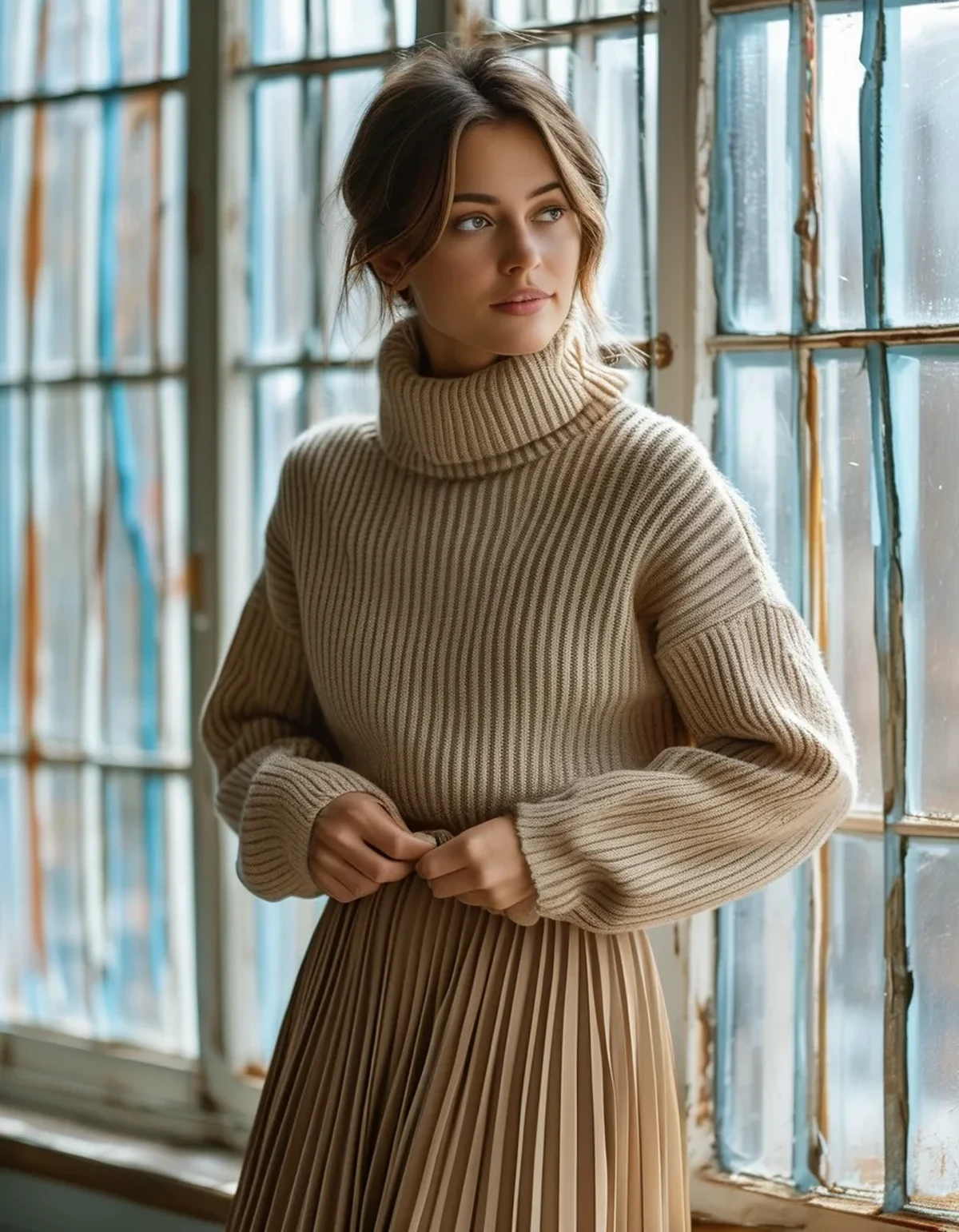
You pull the sweater over it and something goes flat — not bad exactly, but school-uniform adjacent, and heavier than either piece deserves.
Nothing is wrong with the pieces. Two volumes are meeting at the same point on your body, and that point is your waist.
Why do the two pieces fight each other?
Because they both put their fullest point in the same three-inch band.
A pleated skirt is engineered to hold volume from the waistband outward — that is the whole point of a pleat. It flares from the top, which means the widest visual mass begins right where your waist is.
A sweater, especially a relaxed or ribbed one, drapes downward and ends somewhere between the natural waist and the high hip. Its hem is the widest point of the top half.
Stack them and the silhouette goes from shoulder, straight down, straight out. Your actual waist — the narrowest part, the thing that makes the whole outfit read as intentional — is now hidden under two layers of fabric at once.
This is the mechanism behind almost every version of this complaint. It is not about the sweater being too big or the skirt being too short. It is about overlap at the widest common point.
Fix one: define the waist
Three options, in ascending order of effort.
The half-tuck. Tuck the front third of the sweater into the waistband and leave the rest out. This reveals the waistband on one side, which tells the eye where your waist is, while keeping the relaxed feeling of an untucked knit. It works because the eye only needs one reference point, not a full outline.
The full tuck with a fine-gauge knit. A thin merino or cotton sweater tucks cleanly. A chunky one will not — it bunches, and the bulk goes exactly where you were trying to remove it. If you want a full tuck, the knit has to be fine-gauge.
The visible waistband or belt. If the skirt has a substantial waistband, use it. A half-inch to one-inch belt in the skirt’s own color family is more effective than a wide contrast belt here, because you want definition, not a horizontal line cutting the outfit in half.
The cheat that also works: a shorter sweater. A cropped or waist-length knit ends above the skirt’s volume rather than in it, which solves the whole problem with no tucking at all. This is why cropped knits and pleated skirts became such a fixed pairing — it is a structural solution, not a trend.

Fix two: move the volume upward
If you do not want to touch the waist, change where the sweater is fullest.
Choose a sweater with shoulder interest. A slightly dropped shoulder, a raglan seam, a subtle puff — anything that puts visual mass at the top. The silhouette becomes wide-narrow-wide, which reads as deliberate, rather than straight-wide, which reads as bulk.
Push the sleeves up. Pushed sleeves narrow the arm at the forearm, which is a small change with an outsized effect. It creates a visible taper and it exposes the wrist, which is one of the reliable levers for making a heavy knit look lighter.
Use a v-neck or an open collar. Vertical space at the neckline lengthens the top half and pulls attention upward and away from the waist junction. A crewneck plus a full pleated skirt is the highest-bulk version of this outfit.
Layer a collar out. A shirt collar over a crewneck adds a crisp line at the top, which is where the whole tenniscore reference lives anyway. It also quietly makes the sweater read as a layer rather than as the main volume.
Myth vs Fact: Sweaters and Pleated Skirts
Myth: The skirt is too full. Fact: The skirt is usually fine on its own — you already checked. The issue is overlap, so changing the top is the cheaper and more reliable move.
Myth: Oversized-on-oversized always works because it is a trend. Fact: Deliberate oversized styling works when the two volumes are offset — big top with a narrow skirt, or a full skirt with something fitted. Two volumes meeting at the waist is the version that reads accidental.
Myth: Tucking is dressier and therefore wrong for a casual look. Fact: A half-tuck is specifically an informal gesture. The fully smoothed, fully tucked look is the formal one; a slightly loose front tuck reads relaxed.
Myth: A longer sweater is more flattering. Fact: A sweater that ends at the widest part of the hip is the least flattering length in this particular combination, because it lands where the pleats are already fullest. Either shorter or clearly longer works better than exactly there.
Myth: You need a belt. Fact: You need one visual cue that a waist exists. A belt is one option; an exposed waistband, a tuck, or a fitted knit are all equivalent.
FAQ: Tenniscore Layering Questions, Answered
What shoe keeps this from reading like a uniform?
A slightly unexpected shoe does most of the work. A loafer, a boot, or a chunky sneaker breaks the schoolgirl reference that a plain flat or a white tennis shoe reinforces. As the weather cools, a low boot is the easiest swap.
Does this work with a sweater vest instead?
Better, usually. A vest has no sleeve volume and typically ends higher, so it adds pattern and texture without adding width at the waist. It is the low-effort version of both fixes at once.
What about a cardigan?
A cardigan is easier, because the open front creates two vertical lines down your torso and implies a waist even when it is not defined. Leave it unbuttoned; buttoning it up recreates the original problem.
Fine-gauge or chunky for early fall?
Fine-gauge is the more versatile purchase — it tucks, it layers under a jacket, and it works through a warm September afternoon. Save the chunky knit for when the skirt gets swapped for something narrower anyway.
TL;DR:
- The problem is two volumes — pleats flaring out, sweater hem ending — meeting at the same point at your waist.
- Fix one: give the eye a waist. Half-tuck, fine-gauge full tuck, or a visible waistband.
- Fix two: move the fullness up. Shoulder interest, pushed sleeves, a v-neck, or a collar layered out.
- Avoid the sweater length that lands at the widest part of the hip — shorter or longer both work better.
The pieces were right the whole time. They were just both trying to be the widest thing at the same altitude.
See It in Motion
Seen here: UPF 50+ Pleated Running Skort with 26” Leggings & Pockets — shop similar styles on bubblelime.com
Keep Reading
This article is for general informational and styling purposes only. Fit, sizing, and product availability may vary.