The Sweater Vest Proportion Rule That Decides If Tenniscore Reads Chic or Costume
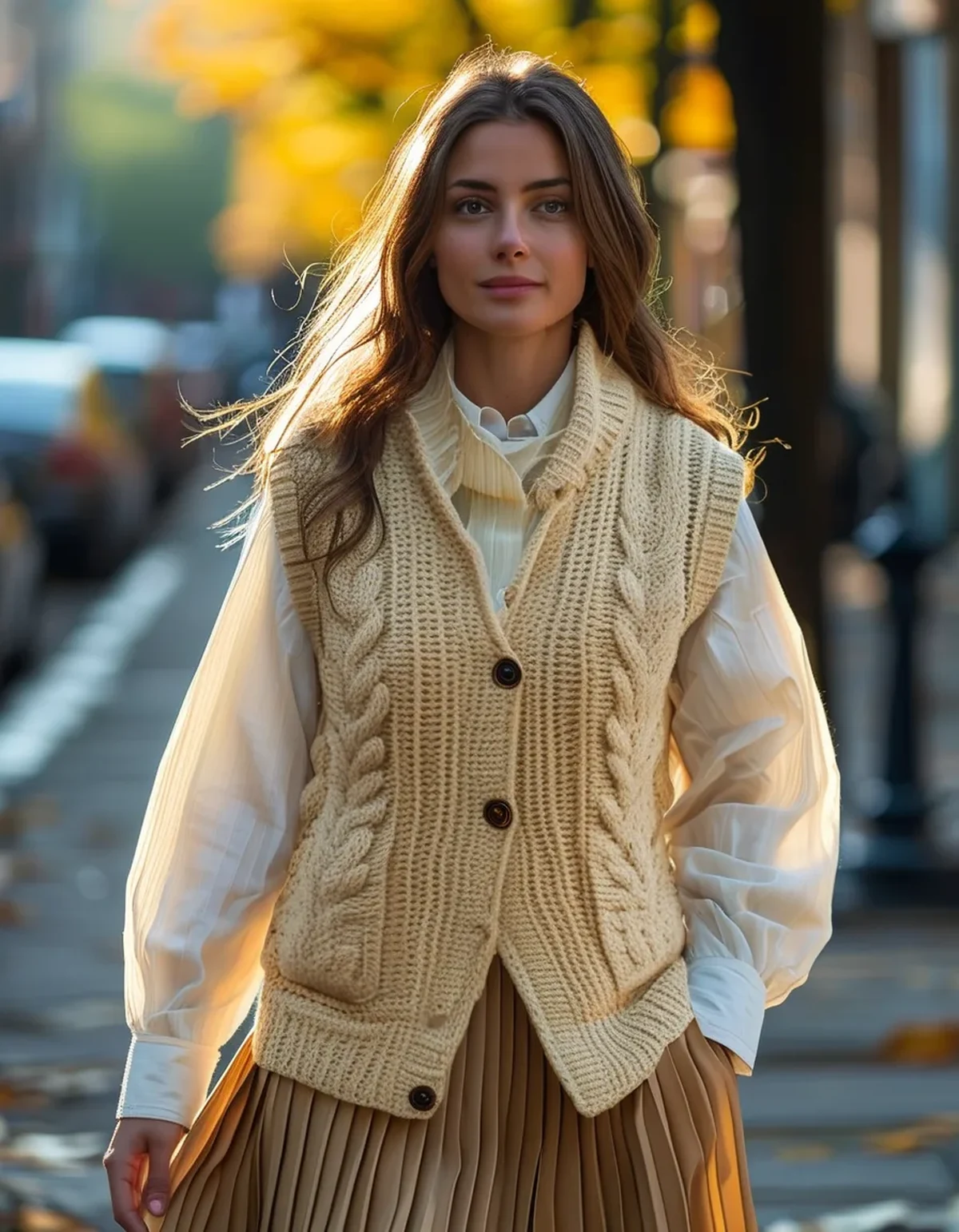
Quick Answer: A sweater vest reads chic when its hem lands at or just above the narrowest part of your waist and the layer underneath extends visibly past it. It reads costume when the hem hits mid-hip and the whole torso becomes one uninterrupted block. The second rule matters nearly as much: the shirt underneath should show at the collar, cuff, and hem — three points of visible contrast. Miss those and even an expensive vest flattens the outfit.
The vest looked perfect in the shop. On you, at home, it looks like a uniform that doesn’t belong to you. The fit is fine. The length is the problem.
Why do some sweater vests look chic and others look like a costume?
Three variables, and length is the dominant one.
1. Hem placement. A vest that ends at or just above the natural waist creates a visible waist and a proportion break. A vest that ends at mid-hip covers exactly the point where your shape narrows and turns the torso into a single rectangle. This is the difference most people feel and misattribute to fit.
2. Visible layering points. The reason a vest works over a shirt is contrast — collar at the neck, cuffs at the wrist, shirt hem below the vest. Three points of visible layer. A vest worn over a plain t-shirt with none of those points reads as an odd sleeveless sweater rather than an intentional layer.
3. Armhole depth. Deep armholes that expose a lot of the shirt at the side read relaxed and slightly oversized, which works with a fuller shirt. Close armholes read neat and preppy, which works with a fitted shirt. Mixing them — close armholes over a voluminous shirt — creates bunching that photographs badly.
The costume risk specifically: tenniscore borrows directly from actual uniforms, and the closer the whole outfit is to a literal uniform, the more it needs one deliberately off note. A vest, a collared shirt, a pleated skirt, and knee socks together is a costume. The same vest, shirt, and skirt with loafers and bare ankles is an outfit.
And fabric weight decides the season. A fine merino vest layers under a coat in November. A chunky cable vest is the outer layer in September and unwearable under anything.
Where exactly should the vest hem sit?
By silhouette below, which is what actually determines it.
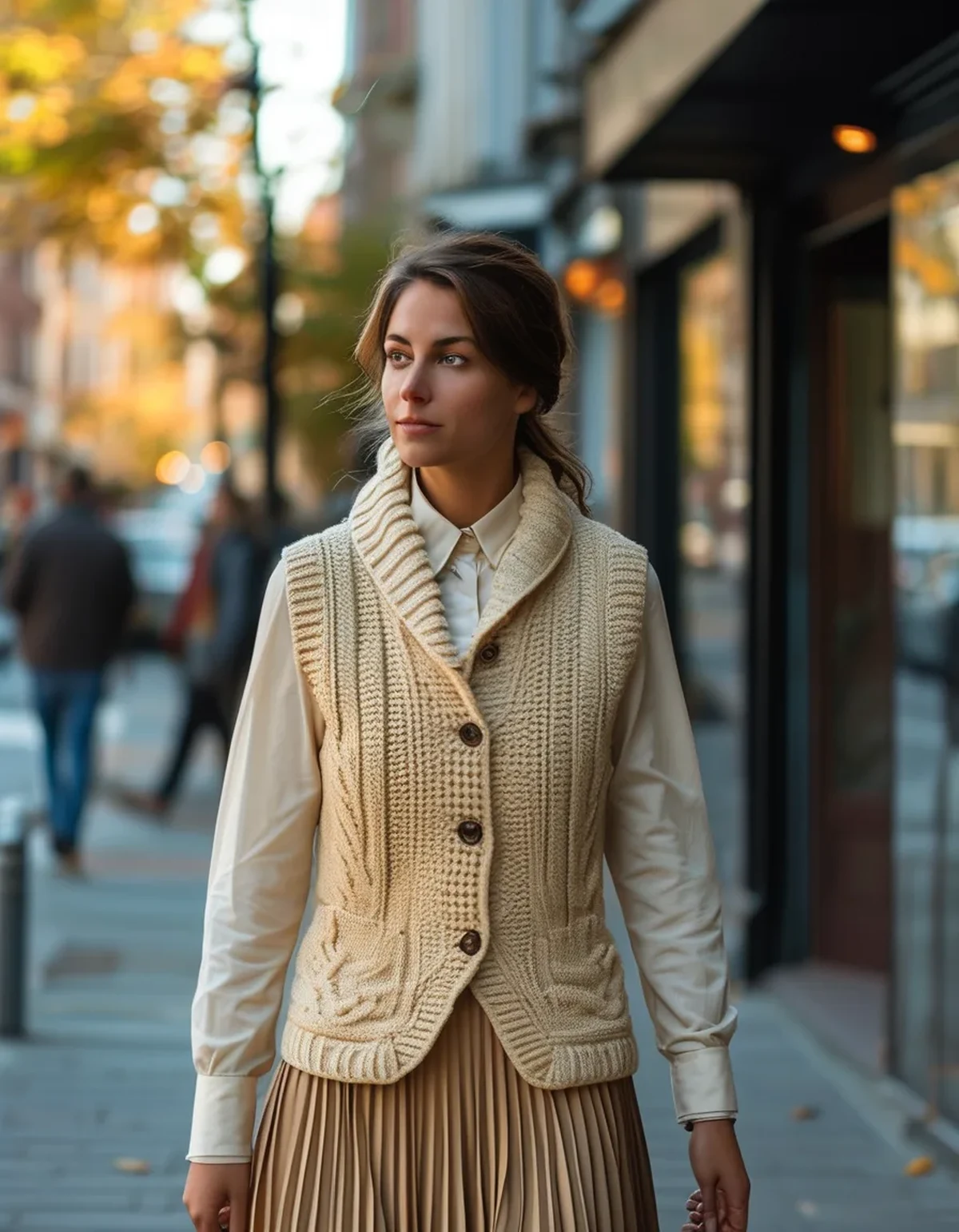
With a high-waisted pleated skirt: hem at or just below the skirt’s waistband. This is the classic and the most forgiving — the vest ends, the skirt begins, and the waist is defined by the meeting point.
With high-waisted trousers: same principle, hem at the waistband or an inch below. A front tuck is unnecessary and usually bulky in knit.
With mid-rise jeans: the vest should end above the hip bone, showing an inch or two of denim waistband. Below the hip bone and you lose the leg line entirely.
With a dress underneath: the vest can run longer, to mid-hip, because the dress provides the vertical line and the vest reads as a layer rather than a torso. This is the one case where the long vest works.
The universal test: stand side-on to a mirror. If the vest hem and your widest hip point are within an inch of each other, it’s the wrong length. Either shorter, to the waist, or longer, past the hip, but not at it.
On sizing: buy for the shoulder and the armhole, not the body. Knit vests have enough give in the body that a close shoulder with a slightly relaxed body reads intentional, while a tight shoulder never recovers.
A practical note on cropped vests: they work beautifully over high-waisted anything and terribly over anything mid-rise, because they expose a band of shirt at the waist that reads unfinished rather than layered.
5 Ways to Style a Sweater Vest Without the Uniform Look
1. Break one rule of the reference deliberately. If the vest, shirt, and skirt are all classically preppy, the shoes shouldn’t be. Loafers are fine; chunky loafers, a worn sneaker, or a western boot are better. One anachronistic piece is what turns reference into style.
2. Layer over a longer shirt, not a matching one. An oversized poplin shirt with the hem showing several inches below the vest, sleeves rolled to the forearm, is the single most reliable modern version. The proportion contrast does the work.
3. Wear it over a fine turtleneck instead of a collared shirt. This removes the school-uniform collar entirely while keeping the layered structure. Best in a matching or tonal color for a quieter, more grown-up read.
4. Go tonal rather than contrast. Cream vest over a cream shirt with a camel skirt reads expensive. Navy vest over a white shirt with a navy pleated skirt reads like a school crest is missing. Contrast piping and bold color-blocking are the strongest costume signals in the whole category — the argyle-and-tipped-collar combination in particular.
5. Take the skirt out of it entirely. Vest, shirt, and straight-leg trousers or well-cut jeans is the version that works on a Tuesday. The pleated skirt is what makes the reference literal; without it, the vest is just good layering.
The one nobody mentions: sleeve length under the vest changes the whole register. Rolled sleeves read casual and current, buttoned cuffs read formal and closer to uniform, and a long sleeve pushed to a soft bunch at the elbow is the most flattering of the three for most arms.
How does this work for early fall specifically?
This is the vest’s actual season, and the reason it’s everywhere right now.
The temperature problem it solves. Early fall in most of the US means 55°F mornings and 75°F afternoons. A vest adds warmth to the core without committing to sleeves, so the shirt underneath handles the afternoon and the vest handles the morning. It’s genuinely the most practical layering piece for a 20-degree swing — more useful than a cardigan, which you have to carry once removed.
Fabric weight by month:
- Early September: fine gauge cotton or cotton-blend, worn as the only layer over a shirt
- October: merino or lambswool, mid-gauge, still outer layer with a light jacket for mornings
- November onward: chunkier knits under a coat, or fine gauge as a mid-layer
Color for the season: cream, oatmeal, camel, olive, and grey do more work than the classic navy-and-burgundy. The heritage colors are exactly what push the look toward uniform.
Shoe transition: bare ankles with loafers work through September and into October in most of the country. When socks become necessary, a ribbed sock in a color that matches the trouser or shoe extends the line — a contrast crew sock is the fastest route back to costume.
On knee socks: they’re the single strongest costume signal in tenniscore, and they’re everywhere in the imagery. If you love them, they need everything else in the outfit to be adult and unfussy — no pleated skirt, no collared shirt, no argyle.
The layering order that works when it’s genuinely cold: shirt, fine vest, then a structured jacket or trench. A chunky vest under outerwear creates bulk at the armhole and ruins the jacket’s line.
How do you buy one that lasts?
Vests are cheap to make badly and the failure modes are predictable.
Check the gauge. A tighter, denser knit resists pilling substantially better than a loose, airy one. Hold it to the light — if you can see through it easily, it will pill at the underarm and the front where a bag rubs.
Fiber, in order of practical value:
- Merino wool: best all-round. Warm, breathable, holds shape, resists odor.
- Lambswool: slightly softer, slightly more prone to pilling, good value.
- Cotton and cotton blends: best for early fall and warmer climates, less warm, prone to stretching at the armhole over time.
- Cashmere: softest, warmest for weight, and the most fragile — pills quickly at friction points and is expensive to replace.
- Acrylic and acrylic blends: cheapest, pills fastest, and reads synthetic under most lighting. Fine for a trend season, not for a wardrobe piece.
Inspect the armhole and neckline ribbing. These are the first areas to lose shape. Ribbing should feel dense and spring back immediately when stretched. Slack ribbing on the rack is already failing.
Check the shoulder seam placement. It should sit at your actual shoulder point or slightly beyond for a relaxed cut, never inside it. A seam falling short of the shoulder makes the whole vest look small regardless of body fit.
Care that extends life: fold, never hang — hanging distorts the shoulders permanently in knitwear. Wash cool or hand wash, dry flat. De-pill with a proper sweater comb rather than a razor, which cuts fibers and accelerates the problem.
Realistic lifespan: a good merino vest, worn once a week in season, should look right for four or five years. An acrylic one is usually visibly tired by the second season.
FAQ: Sweater Vest Questions, Answered
Can you wear a sweater vest without a shirt underneath?
Yes, and it’s a different look entirely — closer to a knit tank than to layering. It works best in a fine gauge with a higher neckline and a structured bottom half. What doesn’t work is wearing it over a plain t-shirt, which loses all the layering contrast without gaining the cleaner sleeveless line.
Should the vest be tighter or looser than a sweater?
Slightly closer through the body than you’d wear a sweater, because there are no sleeves to balance volume. But the armhole should never bind. If you’re between sizes, size up and accept a slightly relaxed body — a tight armhole is the one thing you can’t style around.
Is the sweater vest going out of style?
It cycles, but the fine-gauge tonal version has been a wardrobe staple for decades independent of the trend. The heavily patterned, contrast-tipped, argyle version is the trend-dependent one. Buying the quiet version in a good fiber is a low-risk purchase.
TL;DR:
- Hem at or just above the natural waist reads chic; hem at mid-hip turns the torso into a block.
- Show three points of the layer underneath — collar, cuff, and hem — or the vest reads as an odd sleeveless sweater.
- Break the reference with one non-preppy element; the full uniform of vest, collar, pleats, and knee socks is a costume.
- Buy merino or a dense cotton, check the armhole ribbing, and fold rather than hang.
The vest isn’t the risk. Wearing all five reference pieces at once is.
See It in Motion
Seen here: UPF 50+ Adjustable A-Line Running Skort with Pockets — shop it on bubblelime.com
Keep Reading
This article is for general informational and styling purposes only. Fit, sizing, and product availability may vary.